“Turkey Does Have Any Plan to Revitalize the Ottoman Empire,” Stresses Turkey’s Ambassador in Tehran.
- Diplomatic Dialogs Exclusive Interviews
admin
- 0
- 24 minutes read
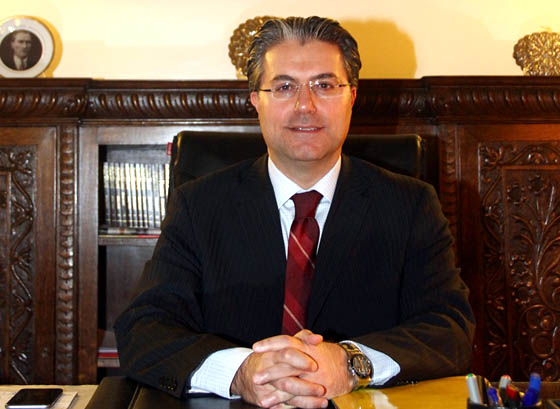
Coming from the Justice and Development Party, the government in Turkey cares much about the national and historical symbols and well knows if the tomb of King Suleiman had been destroyed by the ISIS, then, a unanimity among Conservatives, Nationalists, Leftists and every other political and security element in Turkey would have accused it of inefficient ruling. In addition, such a thing could have caused various sociological and psychological consequences accordingly. That is why Turkey’s PM, Ahmet Davutoğlu decreed an order to the Army to transfer the corpse of King Suleiman, the founder of the Ottoman Empire, from Syria to Turkey by performing a wide-scale military operation successfully. The operation somehow indicated Turkey can be stunningly strong in terms of its military capabilities should it be called for it against the ISIS. Furthermore, to bring back the Ottoman Empire to life by the modern-age politicians has surprisingly been paid attention to lately. To delve deeper into the developments in the region and also the approach of Turkey toward the ISIS, we held an interview with Turkey’s Ambassador in Tehran, Mr. Reza Hakan Tekin,
AVA Diplomatic’s Exclusive Interview with
Mr. Reza Hakan Tekin, the Ambassador of Turkey in Iran
Interview by Mohammadreza Nazari
Last year, we continuously witnessed the ISIS rising to unexpected power in Iraq. Had Turkey’s Intelligence Service anticipated that?
What the ISIS did in Iraq needed no intelligence element to be resorted to. After 2003, Iraq had hard times dealing with peace issues, esp. between 2006 and 2008 when religious feuds took place between different groups. There was a relative peaceful trend later, however. But since December, 2011, when the US troops left Iraq, Mr. Maliki’s administration began to implement a recipe the day after and executed a number of agendas which led to further instability in the country.
We look at the ISIS or Al Qaeda as a façade of the fiasco but not the roots of it, and that’s a problem. Unfortunately, extremist groups are everywhere in the world and that’s a shame they will continue to be. What really matters, though, is the fact that they be pushed to the curb and come under control and we should not allow them to abuse those demands which have people’s wish or request in them. That is the mistake made now in Iraq, for large walks of people hold almost no feeling or sense of belonging to their own country and feel they are unwantedly restricted to sidelines. Al Qaeda or the ISIS put on a smart deceit and made the most of such trends. Turkey, of course, had been warning all countries somehow related to Iraq on these security issues during the past 3-4 years.
According to your explanations, I wonder why Iraq’s Intelligence Service, esp. that of its army, was taken aback by the process of the ISIS gaining power or the demise of Mosul.
You should ask the Iraqi authorities, but I can offer you a few points. When we look back at the incidents in last June, we realize that they happened very fast and consecutively and that could yield an interesting aspect. Back then, a population of so-called 2-3 thousand people came to Iraq from the east and occupied Mosul in 4-5 days, while there were over 70 thousand Iraqi forces there. Yet they fled to the south of the country without even shooting a single bullet; they had lost everything beforehand and had even taken off their uniforms and left all their light and heavy weapons behind.
It should be noted that they didn’t consider Mosul to deserve defense and left it right there. So military authorities should be inquired on this. Iraqi forces retreated anyway and took back the defense line to around Samara. Perhaps that act could send a message, “We only defend a certain percentage of people, for we are only able to defend that part.” That is a bitter example which occurred in Iraq. In fact, a national identity has not been formed in the army.
Turkey’s PM has maintained the existence of the ISIS stems from the violence in Iraq and the dissatisfaction of the Sunnis. But I wonder to figure who the ISIS forces managed to transfer heavy weaponries and military equipment from Syria to Iraq whose transfer is not easily possible. Such a logistic move could not be carried out without the support of a third-party country.
Instead of looking for a third-party country, we should look for a mechanism which can work inside the country. In the beginning, some thought the ISIS was a caravan of thieves. But as time went by, it became obvious that they are a professional terrorist organization. A militant group which proficiently uses military strategies.
On a note about Iraq, you should know that Saddam’s commanders widely contributed to this group both militarily and strategically. However, if in 2003, a national peace agreement had come into existence, maybe these people wouldn’t have tended to joint such terrorist groups and help them.
What has taken place in Iraq was the procedure of implementing the law of the infiltration of the Baath Party which is still ongoing. That law was executed fiercely and drove millions of Iraqis out of the game. Though, the new government has taken a number of measures to soften the atmosphere.
I want to stress that misunderstandings should not occur again. I don’t mean to picture terrorist groups as rightful sides, but I seek to explain what gave them a fertile ground to grow, for if we don’t properly detect the cause, we can’t offer a well-pitched solution.
What measures have been taken by the Government of Turkey to fight the ISIS? Why did Mr. Erdogan state amidst the formation of the anti-ISIS coalition that to protect the lives of Turkish citizens means much more than Turkey’s participation in the coalition?
You should analyze those stances right when they were stated. You know one of the early measures of the ISIS after occupying Mosul was to attack Turkey’s Consul General there and they held hostage nearly 45 Turkish citizens.
During the 101 days of the hostage taking process, we had to go with such delicacy and sensitivity in our policies. But in terms of the ISIS, our stances have been pretty clear and straight and we believe it is a terrorist group and should be fought.
It seems that Turkey sees the fight with the ISIS as a winning card with which it can make deals with the US. Mr. Davutoğlu’s statements in his interview with the CNN are a sample of what I mean. In that interview, Mr. Davutoğlu mentioned that Turkey fights the ISIS on the condition that the US guarantees the deposition of Bashar Al Assad.
First off, I should say this is not a correct assessment. Currently, Turkey is an active member of the coalition against the ISIS and makes significant logistic contributions to it. The ISIS is more than anything a national security threat for us, for not all of the coalition members share borders with Iraq and Syria as much as Turkey does.
About Turkey’s policies and Mr. Davutoğlu’s statements, we wanted to point out that a fight is supposed to be carried out against the ISIS, it should happen in the form of a fundamental measure. I mean if we can have an extensive plan to uproot what has given power to the ISIS, Turkey will be naturally more active then. But to say Turkey does not help at all isn’t fair.
In regions where Kurds settle in Syria, there are small autonomous governments related to the Democratic Union Party which is close to P.K.K in terms of their basic ideologies. Would further clamping down on them by the ISIS and Assad’s opponent be to the advantage of Turkey’s national security?
We wouldn’t think so. Their weakening doesn’t mean our national security is taken care of. We believe the more popular governments win the power in Iraq and Syria, the more advantageous it will be to everybody and to Turkey’s security.
Don’t you agree that the weakening of these forces is to Turkey’s advantage?
No, I don’t. We don’t want any group or people to be weak. What we want is for all walks to own a share in the government in power.
When the ISIS was advancing to Kobani, every TV channel in the world was displaying the fights on the borders of Turkey and almost everyone expected the Turkish army to prevent the advancement. Why did some movements start when a major part of Kobani fell?
I would like to give you a few lines of explanation about Kobani. When the ISIS besieged Kobani, Turkey left its borders open and received around 200 thuosand of Kobani borthers and sheltered them.
As a point of fact, we were the first country to help our Kurd brothers. But the world gave life to an atmosphere as if the problems of Syria had all piled up in Kobani, for Kobani had borderlands with Turkey and every reporter and camera from all around the world was dispatched there all through the borders between Syria and Turkey and had live broadcasts.
It is being said anywhere that PKK and PAD are experts of propagandas. During those days, in other parts of Syria there were vast bloodsheds, too, and even when Halab was being bombarded by the Syrian regime, no one paid much attention to any them but Kobani.
As you know, what we did afterwards was to allow the Pishmerga forces of Iraq go to Kobani’s aid through Turkey and push back the ISIS in a way. In a message, Mr. Barzani congratulated the Turkish officials after Kobani was freed and announced the operation came to realization with Turkey’s help.
The operation, however, was conducted so late that Kobani was almost down to pieces.
But at least some 200 thousand non-military individuals from Kobani stayed alive in Turkey. You should, however, note that the buildings shall be rebuilt, but the lives lost and people killed will never be back.
While some countries such as Egypt and Kuwait are normalizing their ties with the Syrian government and considering the fact that Iraq’s PM asked on his trip to Cairo for a change in Turkey’s stances toward Turkey, are we bound to see any modification in the stances of Turkey toward Syria?
We are not a country which makes a move only because other countries say so. What others do, of course, is totally related to their own attitudes. We determine our policies in accordance with our national interests and values which are formed based on global norms.
What is the viewpoint of Turkey toward the continuation of Assad’s administration?
You would most probably know your answer already based on our stances.
Shortly after his inauguration, Barack Obama chose Turkey to visit as his first trip as the US new President, and that shows how important the ties between the US and Turkey are. How does Turkey organize its relations with the US considering the developments in the Middle East?
The ties of Turkey with the US have deep roots. The US is our ally within our NATO memberships, anyway. Apart from that, the US is the most powerful country and is regarded as a superpower in terms of its military strength. Not to forget that its presence and operation in our region is an important parameter.
However, in cases where we see it right, we cooperate with the US and in those where we feel something is wrong, we frankly warn them. We are glad, anyway, that they pay attention to what we warned them against, even if it is not in time. But unfortunately, some of the wrong policies of the US have caused a wide range of the ongoing crisis in our region.
Given what you said, I’m interested to know what the last subject you warned the US against was.
For instance, it had been a while during the terms of the former government of Iraq since we began warning our American friends – just like we did toward our Iranian brothers – that those individuals can bring detrimental effects in this field and can boost the problems there, but they didn’t listen to us until a long time afterwards.
Why didn’t the US officials listen to Turkey’s warnings?
I served for 8 and a half years in Los Angeles and New York. I also somehow know how Americans are because of my previous positions. Many magnify the US more than what it really is and think the US has strong planning for everything it does and prepares a certain set of policies for whatever that exists in the world. In Turkey, many think so and I’m sure it is all the same in Iran, too. But my personal experience says that Americans have a certain type of simplicity. Mostly they may not be on a bad intent, but they do what they think right and that sometimes leads to disastrous consequences.
I would like to ask you a question about the ties between Iran and the US, for you said you are familiar with the culture and society of this country. Iran’s Supreme Leader, Ayatollah Khamenei has at times stated in his speeches that the US cannot be trusted in the process of nuclear talks. How do you see this?
We know the history of the Iran-US ties, and that comes from the measures of the US against the Mosadeq Administration, its approach during the war between Iran and Iraq and also its stances about Israel. As a matter of fact, there are various cases which allow Iran to not trust the US and Ayatollah Khamenei’s words cannot be overlooked.
As in interpersonal relationships, it is a fine idea to put yourself in other side’s place on an international basis. In fact, the US, too, has a number of doubts and misconceptions about Iran. Every one of these topics consists of certain parameters which we don’t need to get into. The truth is there is mutual mistrust between them, but some mutual steps can be taken to restore that trust.
To damage the trust is a simple task, but to restore it requires a lot of time and is very difficult. However, considering the trend implemented over the past couple of years, I believe a positive tendency has been born to restore the trust between these two countries. Perhaps that Mr. Obama and Mr. Rouhani are the heads of two countries can be a fine chance to bring back the train of trust on its own track. We wish for a positive trend to be formed, too.
Can the Republicans in the Congress and Senate be a challenge in the way of the Obama Administration?
They can, but in the US, there are some issues related to national interests which are decided upon beyond the demarcations between parties. Apart from that, the US is not a plain black and white picture and even inside the Republicans and the Democrats, there are wide spectrums of different tastes consisted of groups and political schools ranging from moderate to extreme. That is why we should not view the US as a black and white picture. I would think the Congress would do anything against Iran if an agreement to the advantage of Iran and the US.
I like to direct the interview toward the ties between Turkey and the EU.
That story never ends, I guess.
While Germany’s 82-million population makes it the most populated EU country, Turkey’s 75 million can bring it many positions and seats in the council and parliament, for they are divided based on the population ratios. Do you think the EU would allow a Muslim country to gain power there?
That the EU has an unfair approach toward Turkey is pretty obvious. None of the nominees for EU memberships have waited so long. Even those countries which seem underdeveloped compared to Turkey can become a member sooner than that.
Just as countries with weaker economies than Turkey have become a member.
That shows us in a way that our European friends lack a sense of futurism. But Turkey has changed now and cannot beg for an EU membership. Although this issue is still an objective for us, the world doesn’t come to an end if it didn’t happen.
We don’t need the EU, in fact, and they may even need us more. Our economic growth has been achieved without the EU membership, and you can see how some EU members are doing now.
According to polls, in Turkey, people’s inclination for an EU membership was estimated 70% or more, whereas it has descended to less than 30-40%. And that’s because of the policies the EU has taken thus far toward Turkey.
Another topic to get to is the balance of political and economic ties between Turkey and Israel. While political relations between these two are descending, their economic ties are blooming more than before, and Turkey’s Today Newspaper announced on November 28, 2014 that the trades between Turkey and Israel have reached a point of $4.86bn which is many times more than the previous years. In other words, while political relations between Israel and Turkey are getting sour, economic blossoms are blooming widely. How is that happening?
As you know, Turkey’s economy is not that governmental and a major part of it relies on the private sector and it is very active there. In fact, should there be no ban by the international laws, the government will not prohibit economic activists from being here or there. The government doesn’t interfere with those parts, anyway. I don’t know of the trade numbers between Israel and Turkey, however, but there is no governmental incentive to boost this aspect. In terms of political ties, our stances are pretty clear toward Israel and you know it, too.
The Chief of Turkey’s Intelligence Service resigned. Considering his positive point of view toward ties between Iran and Turkey, can that bring security modifications between the two countries?
Turkey’s policies for extending relations with Iran are totally independent of individuals. It is not as if someone’s coming and going changes our policies. People usually come and go, but the policies of an organization will continue.
What is the top priority of the Foreign Diplomatic Service of Turkey in extending ties with Iran?
Our first wish is for Iran to be able to restore its rightful position within the frameworks of the international community, for you do know that there are limitations on Iran because of the nuclear case, and no matter how hard we try to ease into them, they still exist and affect the bilateral relations. Iran is an important player in the region given its past, present and future. That is why we need the constructive helps of Iran to bring back peace and stability to the region. We have never been in favor of isolating Iran and our approach toward Iran in terms of international relations hinges on such a notion.
Some IR analysts believe Mr. Erdogan is after revitalizing the Ottoman Empire. Where is Turkey heading to right now?
Mr. President or other Turkish officials do not have any plan to revitalize the Ottoman Empire or anything of the sort. That they resort to different policies from those of the past is right, for Turkey was mostly oriented toward the west since the very past and has somehow been negligent regarding the regional affairs. But our attention to our own region doesn’t mean we seek to revive the Ottoman Empire, relocate the borders or annex lands.
In fact, we don’t look for changing borders, but we want them to fade away (the world becomes borderless), which means we want the interactions between different nations to be so strong that even borders wouldn’t be able to separate them from each other; just like what is happening today in the EU countries. In other words, that’s a legal matter and people are being comfortably in contact with each other. We would like for the people of Iran and Turkey to easily and fast maintain their connections.
But there are some symbolic moves in Turkey which emit signs of revitalizing the Ottoman Empire. For example, for the first time during the celebration of receiving Mahmoud Abbas, Mr. Erdogan used Ottoman clothes and armors to dress the welcoming guards.
Every country prides in its own history. We, too, just like Iran, feel proud of our history. The Ottoman Empire is undoubtedly an honorable part of our history. We see now how the region is suffering after the demise of the Ottoman Empire. We see what cruelty is being imposed on our Palestinian brothers. But we can rewind the time. The talks, however, about the revival of the Ottoman Empire aren’t right. We would want the people of the region to stand on their own.