“I Was Deeply Influenced by Doubts and Ambiguities in Khayam’s Poems,” States Ecuador’s Ambassador
- Diplomatic Dialogs Exclusive Interviews
admin
- 0
- 19 minutes read

A country of 14 million population, Ecuador stands among scarce countries whose currency is still USD and enjoys a low inflation rate which has fluctuated for 2-4% tops over the recent years. Quito, its capital, is a city of green and historical gestures where one might find one of the world’s best climates ever which obviates the use of heating or cooling equipment. Ecuador also harbors the Amazon forests, roaring rivers, natural lakes, erupting volcanoes, Pacific coasts and the famous Galapagos Islands where rare varieties as well as the common of flora and fauna can be found serving as a major tourist attraction therefore forming a lion share of the country’s economy. Ecuadorian citizens are entitled to sail through the Latin America only by owning an Ecuadorian ID card and holding an Ecuadorian passport in their hands in addition to having the right to visit over 70 countries without being needed to have their visas issued. The country won its independence in 1830 and before that, it was a protectorate to Spain and the Great Columbian Republic. To inspect the relations between Iran and Ecuador, we held an interview with Ecuador’s Ambassador in Tehran.
AVA Diplomatic’s Exclusive Interview with
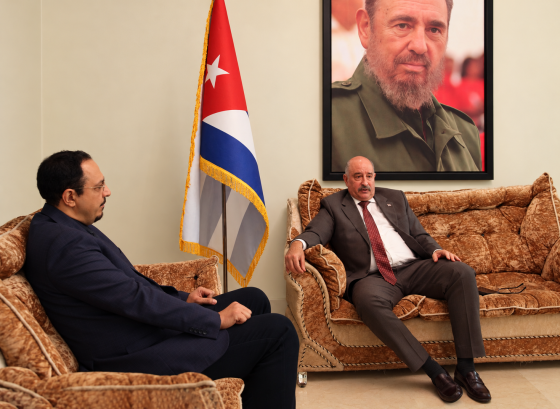
Humberto Vinueza Rodríguez, the Ambassador of Ecuador
When did you first come to Iran? What had your responsibilities been before?
Prior to February 9, 2013, the date on which I arrived to the city of Tehran as Ambassador, I worked as Advisor to the Minister of the Interior of my country.
What other positions have you been assigned to at Ecuador’s Ministry of Interior?
In the public service, I worked with the Ministerio Coordinador de Patrimonio Natural y Cultural (Ministry of Coordination of Natural and Cultural Heritage). Prior to that, I was active in the area of sustainable rural development and cooperatives. And I was also professionally engaged in the private sector as a regional planner. But above all, I am a writer and a poet.
How different did you see the image of Iran before and after your official presence in Tehran?
The image I had of Iran was supported by my affection for Persian poets like Hafez and Omar Khayam, whose poems I read in my youth translated it into English and Spanish. The idea of Iran as a country was linked to the events in the overthrow of the Shah and the advent of the new authorities with Ayatollah Khomeini at the head. The basics of the transformation of the new Iranian state were for me, if it fits the term, very abstract. Now I can share the daily life in the middle of Iranian society find consistency and coherence in the functioning of the Islamic State.
How familiar are Ecuadorians with the developments of the Middle East?
In the last decade, the ties between the Middle East and Latin America have experienced an unprecedented boom. The inter-regional agenda has expanded in a formidable way. From my point of view, both regions are overcoming their customary marginal status to acquire an increasingly higher profile as opportunities arise and expectations grow in the political, commercial and cultural fields. This fact has not gone unnoticed by the political organizations of my country, as well as by educational and research institutions and by the mass media. Some intellectuals question whether relations between Latin America and the Middle East are part of a restructuring of the world order and what should be a global perspective on the strategic, economic, diplomatic, cultural and political dimensions of these two developing regions that seek to enforce their ideas in the international scene and to actively participate in its development and growth. I believe these concerns are common to those raised in other parts of our continent and I guess also in the Middle East.
Do Ecuador’s universities have Iran and East study centers?
No university has created any centre specialized on Iran or the Middle East region. As far as I know, there is only one Chair of Persian language at the Universidad Católica in Quito.
How are the viewpoints in Latin America toward Iran’s Revolution?
In spite of constant distortions and slant interpretations on the foundations and scope of the Islamic Revolution in Iran and of course, on the resulting Islamic character of the present Iranian republic, common people show now a real interest in knowing about the details of the situation in this country, with which Ecuador has established diplomatic relations. But there are media distorting concepts and facts related to Iran and the Middle East region, as if natural. This is so because events straining and stirring up every-day life in this part of the world, like the Palestinian-Israeli conflict, the intervention in Libya, the Iranian nuclear issue, the crisis in Syria, the developments in the Lebanese political scene, the Saharawi issue and the presence of the group calling itself ‘Islamic State of the Middle East’ (and threatening to create a ‘caliphate’ for itself on Iraqi ground), recruited, trained and financed by Western powers and their allies Saudi Arabia and Qatar, these events as I say have become in the last year a matter of positioning for Latin American diplomatic services.
However, political analysts have fluctuated between two clearly defined positions to understand the impact of the Iranian presence in the region. On one side, they have undervalued this position and considered military diplomatic, commercial and Iranian efforts as the eccentricities of an extremist government. On the other hand, Iranian presence has been seen as a natural and even beneficial transformation in the international scene including the arrival of new powers to our continent and the inevitable decline of the United States’ influence.
Iran and Ecuador enjoy rich cultures and civilizations; how can they use these backgrounds to further their ties?
Persian culture is seen in my country as very important due to the political, religious, historical weight Persia (Iran) had in this area for more than 25 centuries almost without interruption. I would say between the educated public the simple mention of the expression ‘Persian culture’ arises an interest perhaps because of its evocations or maybe because they see in ‘Persian things’ a non-Arab Muslim Orient covering the Indian, Afghan, Pakistani and Turkish worlds, these being rarities which deserve to be approached and studied. In this respect, the languages we speak in our countries are, so to speak, the broadest portal through which the meaning of our cultures comes and goes. It is known that Spanish language started being taught in Iran twenty years ago and at present, it is becoming the most demanded foreign language after English. Unfortunately, we can not say the same thing neither about Persian nor about any other Iranian language in Ecuador or Latin America.
On the other hand, our countries’ cultural heritages are open books in which our respective citizens recognize themselves and take from this recognition their sense of identity and legitimacy, resulting in a self-esteem based on self-awareness about their historical development; all of which bestows a healthy sense of provenance, belong and destiny (where do we came from, who are we and where are we going to) that guides our actions in the present.
The value of our cultural heritages lies, therefore, in the social functions they fulfil as living organisms, generating elements of social cohesion, cultural identity and political legitimacy. But that is not all. A hallmark only begins to exist in reality if we may say, when the dynamic meaning of culture embodied in heritage starts to function in an interchange process with another culture or more. From this point of view, the relation between Iran and Ecuador can be very broad inasmuch as we give an orientation to their social use. First, towards the scientific dimension in the fields of Archaeology, Anthropology, Sociology, History, etc.; and secondly, in an economic dimension related to tourism, cinema, theatre and generally speaking with performing arts.
The importance and need for its conservation derives also from these functions and therefore, destroying it equals destroying ourselves since its deterioration or disappearance implies the disappearance of history itself, the disappearance of the very sense of selfhood and specificity, and the cultural basis of the mechanisms of political legitimacy before other nations. In the case of our two countries, a common trait exists that is to be multicultural and multi-ethnic countries having staged a conflictive interculturality throughout their history. In this regard, cooperation can point out issues of critical knowledge of our heritages, as well as all the specific measures needed for the preservation of sites, artefacts, expressions and people shaping it. Iran’s experience in this area is of utmost importance.
What are the most important commonalities of Iran and Ecuador?
A common feature between the two peoples, which is related to the sense of attachment and active family membership is noted not only nuclear but extended. Perhaps another important feature is the open expression of emotions and feelings, especially through their music and popular songs.
How can Iran and Ecuador cooperate more in the international scenes?
At present, Ecuador and Iran are taking part and maintaining shared positions in some issues and areas of multilateral relations. Along this way, new tasks shall be defined that raise the level of our achievements as countries belonging to very dynamic regions.
How do you assess the trade potentials between the two countries?
Very promising. We have been discussing with the authorities of the Iranian government about the real possibilities to realize a sustained trade online in time devoted to products like fresh fruits, including bananas, also shrimp, coffee and tuna. This will depend on progress in the negotiations to lift trade and financial sanctions on the country.
When will the strategies be finalized for bilateral trade and cooperation?
Rapprochement with Iran is not a sign against the United States or against any country. President Correa has explained this rapprochement process between Iran and Ecuador is based on a sovereign decision of both countries, bearing in mind that the Iranian economy shows a high degree of complementariness with that of Ecuador. Within this framework, we are defining the agenda for the holding of the 3rd Joint Commission between Iran and Ecuador on a ministerial level in Quito, during the last half of this year and the first one of next. At this event, the goals and means required for strengthening bilateral relations will be precised.
How do you see Iran’s détente approach toward the U.S.? How effective do you find it in the expansion of Iran-Ecuador ties?
Ecuador, from the first presidency of the economist Rafael Correa, has remained a sovereign position in its international relations and in the case of Iran, has been frank and open his friendly and respectful stance. The implementation of the initial phase of the program to lift some sanctions on Iran has generated a healthy expectation of almost all governments of the world. The realization of the expected results depends on the fulfillment of the commitments made by both parties, as seems to be happening.
How much change have the political arrangements in Ecuador undergone during past years?
 The current actions of government in Ecuador are focused on eliminating inequities and inequalities in society. The achievements of the administration I represent in the areas of health, education, inclusion of people with disabilities and reduction of foreign debt have already been recognised as the ‘Ecuadorian Miracle’ and their most obvious consequence is political stability. With about 15%, Ecuador has the highest rate of public investment in gross domestic product (GDP) in Latin America, due to the tripling of the tax revenue, based on a well-implemented and efficient collection system. These public investments have led to a transformation of historical proportions in education, health, childcare, roads, ports, airports, telecommunications, power generation, judiciary and security. Ecuador has one of the three most dynamic economies in Latin America, with an average growth rate of 4.2% between 2007 and 2013. It also has the lowest unemployment rate in the region (4.1%) and when it comes to human rights, it is one of seven over 34 countries in the continent that has subscribed to all inter-American human rights conventions.
How different have the political arrangements been after the local election in Ecuador?
On the one hand, the balance indicates that the administrative management of the leading figures of the ruling Alianza Pais Movement has held the utmost dedication and a lot of time to the functions in the government. From now on, our president will begin a process of political consolidation and strengthening of the social base of support for the Citizen Revolution. According to findings of government leadership in local elections in Ecuador, especially in the city of Quito, the people voted for the candidate of the right, which forces remain a political warning to Alianza País. However, I believe that without a doubt, taking into account the results of the overall result of the vote, the Alianza País party is the winner in the last local elections.
Ecuador’s President warned that the fascist extremist rightists intended to occupy the country’s capital on the date of election, February 23. Which states support this party?
It is difficult to define fascism as a political trend, but in this case, President Correa was referring to private sectors belonging to the Chamber of Commerce of Quito who supported the opposition candidate who eventually won the position for Mayor. The fear is that the Mayor would become a space dominated by private interests. I have no information if these leaders of the Chamber of Commerce of Quito are involved with similar groups in other countries. With regard to the statement by President Correa, remember the definition of the former U.S. President, Franklin D. Roosevelt, on fascism as follows: “… The liberty of a democracy is not safe if the people tolerate growth of power in private hands until the point where it becomes stronger than the democratic state itself.»
How do you see the origin of the fascist extremist rightists’ movements?
The origin is in the power groups that have lost their privileges enjoyed by the previous governments, and therefore currently acting in direct opposition to the government of President Correa. One of the main sites of political struggle was the last election campaign, in which bid up the partisan forces to capture the municipalities and prefectures of the country as part of their political strategies.
Let us get to the matter of your presence in Iran now, as the interview is drawing to a close. What is your most outstanding memory from Iran?
The love of Iranian citizens for poetry and poets. Last year I went to the city of Shiraz. The first thing I did, in the early hours of the sunny morning of my first day there, was to visit the grave of Hafez, the poet. When I arrived, I stood at a prudent distance from the tomb, as I saw a very expressive girl 8 to 9 years old, with big black eyes and hair the same colour, who was reading in loud voice the text in a book with the help of an adult, very concentrated elderly woman. Once the reading finished, the woman hugged the girl with tears in her eyes and I noticed the book fell on the ground. On an instinctive movement, I approached, bent down to pick it up and handed it to the girl. After a moment the woman who also had wet eyes took the book in her hands and put it very gently in mine, telling me something I did not understand precisely though I am sure was it was very moving and deeply meaningful. In fact, the book was a bilingual anthology in English and Persian of Hafez’s poems. In the distance, the girl turned her head towards the place they had left me and raised her hand in farewell. I, too, raised my hand, smiled to her and made a gesture to thank her as I pressed the book on my chest. All of this happened in the early hours of a sunny morning, the first day I was visiting the city of Shiraz, and miraculous Hafez can bear witness.
What did interest you in Iran’s culture and rituals?
I first approached Persian culture through History and Literature. As a child and teenager I was dazzled to read the One Thousand and One Nights tales. After that, I was deeply impressed by the scepticism in Khayyam’s rubayat. Later, it was the classical poets from different periods: Attar, Rumi, Saadi and Hafez. And after that, the pioneers of modern poetry, like Nima Youshij and Akhavan Sales. And last, poets Sohrab Sepehri and Forough Farrokhzad, especially her book Rebellion.