“Middle East Has a Long Way to Go Regarding Human Rights,” States Norway’s Ambassador in Iran
- Diplomatic Dialogs Exclusive Interviews
admin
- 0
- 10 minutes read
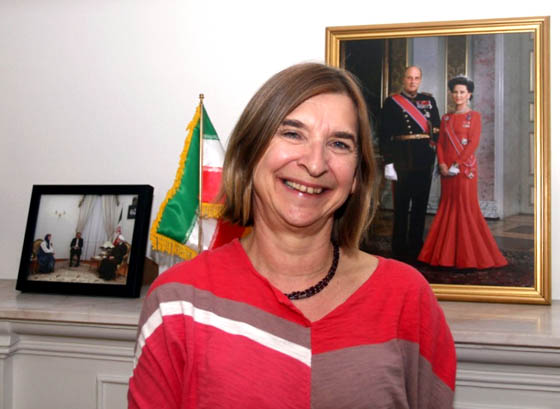
Since the mid-1970s, Norwegian women have played a pretty active role in their country in a way that as of 1981 onwards, there has not been a government without some 40% of women in its body. Apart from the country’s politics, Norwegian women have a considerable share in Norway’s economy and it would not be far from truth to say without the participation of women, Norway could not achieve its current rate of GDP. To gain a better understanding of how Norway’s dynamics are dovetailing in today’s world, we held an interview with Ms. Aud Lise Norheim, Norway’s newly appointed ambassador to Tehran who also has a record for service in the Middle East.
AVA Diplomatic’s Exclusive Interview with
Aud Lise Norheim, Norway’s Ambassador in Iran
Interview by Mohammadreza Nazari
Where had you diplomatically served before coming to Iran?
As a junior diplomat I served in Syria and South Africa, I was deputy at our embassy in Italy and ambassador to Bangladesh and Lebanon before coming to Iran. In between my foreign postings I served in different positions in the Ministry of Foreign Affairs in Oslo. My latest position in the Norwegian MFA was as director general of the UN department. This department is responsible for humanitarian affairs, human rights, gender equality and of course for Norwegian UN policy.
As an Ambassador what are the most important goals since your arrival here?
We see an increased interest in Iran among Norwegian companies and business people. The areas that most probably is are considered to be the most interesting for Norwegian companies, are the petroleum sector, fish farming, green energy and other energy related areas.
What are Iran’s most substantial geopolitical and geostrategic features compared to other Middle-Eastern countries?
Iran is an influential regional actor, and as such has an important role to play in fighting terrorism. Both for Iran and the international community it is of great importance that an agreement is reached in the nuclear negotiations by the end of June this year.
What impacts have President Rouhani’s taking the office had on the relations between the two countries?
Over the last year we have seen an increase in the relations between Norway and Iran. This is of course linked to the optimism when it comes to reaching an agreement between Iran and the P5+1 in the nuclear negotiations.
How do you see the approach of Iranian officials toward expanding ties with their Norwegian counterparts?
Foreign Minister Brende’s visit to Iran in November last year was the first Foreign Minister visit in 12 years. In May this year a delegation from the Standing Committee on Foreign Affairs and Defence visited Tehran. We have also had bilateral consultations on deputy ministers’ level.
Oil and gas are considered to be of Norway’s most important exporting goods. Is there any possibility for Norwegian companies to come to Iran once the sanctions are lifted to take part in extraction and petrochem areas? How much has the global drop in the price of oil affected Norway’s revenues in this field?
As an oil producing country, Norway is also affected by the drop in the global oil price. The decrease in the oil price, however, also represent an opportunity for looking at the structure of the economy, differentiating more and getting less dependent on the petroleum sector. These are issues that are high on the Norwegian government’s agenda.
Iran is constantly trying to have European tourists visit Iran; how do you find the tourism trends in Iran?
Iran is a fantastic country for tourism, and this is a sector that will have to be developed quite substantially to meet the requirements from foreign tourists. Norwegians have also discovered Iran as a tourist destination and we see an increase both in the interest and in the number of people visiting the country.
Which cities and tourism attractions in Iran have you been to thus far?
I, myself, have been to cities like Kashan, Isfahan, Yazd, Kerman, Tabriz, Mashhad and Shiraz – in addition to Tehran of course. All these places have something unique to offer visitors.
Considering your period of stay so far in Iran, which cultural feature of Iranian people best appeals to you?
I like to say Iranians are very hospitable people, so it is indeed a pleasure to travel around the country.
Are there any plans in the pipelines to extend the cultural and scientific interactions between Iran and Norway?
There are also good relations between Norway and Iran in the area of academic and research cooperation, for example between IPIS and the Norwegian Peace Research Institute (PRIO). I would also like to mention that two weeks back an agreement was signed between Azad University and The Oslo and Akershus University College in the area of mass communication and journalism. In addition to this, Norwegian theatre groups have participated in the Fajr festival, and I have reason to believe that cooperation in the area of theatre will continue. It is indeed a pleasure for me to note how well Iranians know the theatre works of Henrik Ibsen and Jon Fosse.
As a Lady Diplomat, how do you find the role of women in Norway’s political and social ballparks?
Women are playing important and active role in Norwegian politics and society. The government is headed by a female prime minister, the finance minister is a women, as is the minister of Defence. More than40 pct of MPs are women. Women are also very active on the labour market, with nearly 80 percent participation. This means that Norwegian women make a huge contribution to the Norwegian economy, without this high participation on the labour market, the Norwegian economy would not have had such a growth over the last years. I do believe that the Norwegian experience is something other countries also should look at. In Iran, for example, women constitute the majority of university students, but have a very low participation on the labour market. What is needed is to create a system that makes it possible for men and women to participate both in the labour market and in the family life in order to encourage more women to use their education. This would indeed be smart economics!
How have freedom of speech, attitude and respect toward other religions been demarcated in Norway?
When it comes to the question about freedom of thought, these are values that we in Norway value highly, even to the degree that we accept that someone may for example say something offensive about another’s religious beliefs. We draw the line at racist remarks, which is something we do not accept. We believe that although respecting people’s religious beliefs are important, it is fundamental for a healthy and free society that its citizens feel free to express their opinion about just about anything, even though someone may feel offended.
Considering your huge and brilliant experience in the field of Human Rights, How do you find the realization of Human rights in the Middle East?
Regarding human rights, I think from a Norwegian perspective, the Middle East does have a long way to go in this regard, unfortunately. I respect that the citizens of the Middle East might see things differently when it comes to drawing the line of freedom of speech, however I think that a healthy society is one where its citizens feel free to say what they like, also publicly, without fear of persecution.I believe that the Universal Declaration of Human Rights are, exactly that, universal and fundamental.