Hungarian ambassador expounds on Iran-Hungary post-JCPOA relations
- Uncategorized
admin
- 0
- 6 minutes read
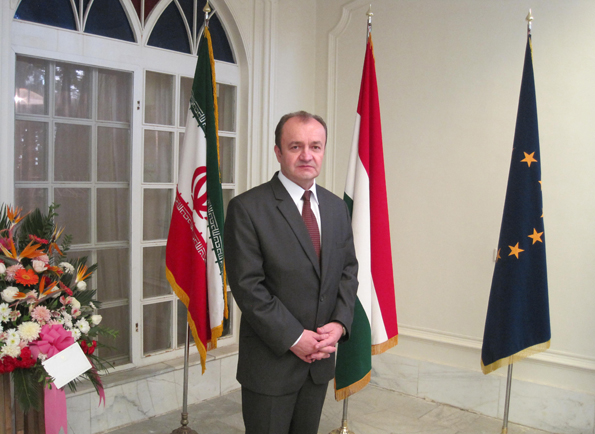
This is a special year for Iran as following a very successful diplomatic operation and the signing of the Joint Comprehensive Plan of Action last July, the post-sanctions era started for the country as of January 16, 2016, AVA Diplomatic reports.
On that date, Iran and P5+1 began the implementation of the Joint Comprehensive Plan of Action, said the Hungarian Ambassador to Iran Janos Kovacs addressing a ceremony at his residence on Sunday to commemorate the 60th anniversary of Hungary’s 1956 Revolution.
The Hungarian Uprising of 1956 was a nationwide revolt against the government of the Hungarian People’s Republic and its Soviet-imposed policies, lasting from October 23 until November 10, 1956. Though leaderless when it first began, it was the first major threat to Soviet control since the Union of Soviet Socialist Republics forces drove out Nazi Germany from its territory at the end of World War II and broke into Central and Eastern Europe.
The function was attended by Iran’s Deputy Foreign Minister for European and American affairs Majid Takht Ravanchi as well as a number of foreign ambassadors and officials to Iran.
Addressing the attendees, after the national anthems of Iran and Hungary were played, Kovacs said, “We are all aware that the Iranian nation is pretty much impatient to see tangible results of the deal. However, I am absolutely sure, that these results are coming. To give an example of the developments in our bilateral relations, in 2015, Hungarian Foreign Minister Péter Szijjártó and, later, Prime Minister Viktor Orbán, leading a huge delegation, visited Iran. We signed a dozen of different agreements and MoUs and paved the way for the upcoming wide range cooperation.”
He added as the outcome of those agreements and deals:
– Managing Director of the Export Development Bank of Iran Ali Salehabadi signed a co-operation agreement with CEO of Hungarian Export-Import Bank (Exim Bank) Zoltán Urbán just three days ago which prepares the ground for both countries to finance mutual business activities of their companies.
– The first Iranian crude oil shipment will leave Iran for Hungary next month and it was right today when a high ranking official from NIOC started his negotiations in Budapest on the prospects of further cooperation in the petrochemical field.
Kovacs said Iran and Hungary signed an Economic Cooperation Agreement last year and plan to have the first session of the Hungarian-Iranian Joint Economic Commission in the near future.
“We have traditionally good ties in the field of culture and education. A few days ago, a high-ranking delegation from Iran’s Shahid Beheshti University visited Hungary to establish cooperation with Debrecen University. We also intend to keep the continuity in our high level political contacts; thus, two visits of such kind are on the agenda as well.”
Commenting on his country’s revolution of 1956 Kovacs said, “This day is special for us, because throughout the whole year in Hungary we commemorate the 60th anniversary of the Hungarian revolution and freedom fight of October 1956.
Elaborating on the symbolic meaning of the red color in Hungarian national flag, he noted that it represents the Hungarian nation’s struggles, sacrifices, heroism and bloodshed throughout its history, the most cherished and remembered of which example is the revolution of 60 years ago.
“That was the time the Hungarian nation said no to a tyrannical regime and to an ideology imposed on it from outside. That was the time when ordinary people decided to take their fate into their own hands. Most of them were aware that they might die on the very simple barricades while fighting with almost their bare hands against tanks and armored vehicles. And this year we remember these heroes.
“Although the Hungarian struggle for freedom and independence — and I believe that these words sound very familiar in Iran: ‘esteghlal’, ‘azadi’ — was finally suppressed by foreign intervention, it is our duty to remember our heroes, their patriotism and pure self-sacrificing struggle.”
Kovacs said although the revolution failed at that very moment, it was far not in vain, adding it had at least two important impacts: An internal one and a international one.
“Internally, the communist puppet government put to power from outside, had to realize that this nation cannot tolerate captivity and will again be ready to fight for freedom and national independence. And as for the international context of the October revolution, it was inspired by the Polish Poznan uprising in June 1956 and followed by the Prague Spring in 1968, which emerged in Czechoslovakia at that time. All of these fights targeted the same goal: To reach freedom, independence and sovereignty.”
Upcoming visits
Speaking at the same ceremony, Takht Ravanchi said Iranian Foreign Minister Mohammad Javad Zarif is scheduled to visit Budapest in early November at the invitation of his Hungarian counterpart, adding László Kövér, the speaker of the National Assembly of Hungary, is to travel to Iran mid-November, invited by Iranian Parliament Speaker Ali Larijani.